

May 14, 2026
Cyber Resilience Engineer: The Making of a New Role (Part I)
By
Spektrum Labs
Expectations for cybersecurity teams are shifting meaningfully. The scope is no longer focused on protection and detection; it now extends to response and recovery. Boards, auditors, and insurers want measurable outcomes from security spending. They also want answers to tougher questions: What happens when we get hit? What's the plan? Will the backups recover? How long will it take? Why did our controls fail? Will the insurer pay out?
All of this is happening while AI reshapes both sides of the fight, attackers and defenders only making it harder to answer those questions.
A typical organization now runs more than 20 security tools (survey data range from 15 to more than 100, depending on company size). Every tool adds a console. Every new framework adds another set of controls. Teams drown in screenshots, attestations, exports, manual reviews, and point-in-time evidence that must be frequently rebuilt. One recent survey found organizations review tool configurations 6.5 times per month on average (Reach Security, April 2026)
And then everyone acts surprised when the proof falls apart the moment it matters most: during an incident.
Resilience can't be a reporting exercise tacked onto GRC anymore.
Some security engineers have taken matters into their own hands. They write scripts, query systems via APIs, and build their own reporting pipelines to reduce manual work. It helps, but it doesn't scale. Others are automating parts of the process, with the trust layer underneath remaining the most difficult to manage programmatically. This includes proof that the controls work, backups recover, compliance requirements are met, and insurance conditions are met, in a form that's always up to date, machine-readable, and easy to share.
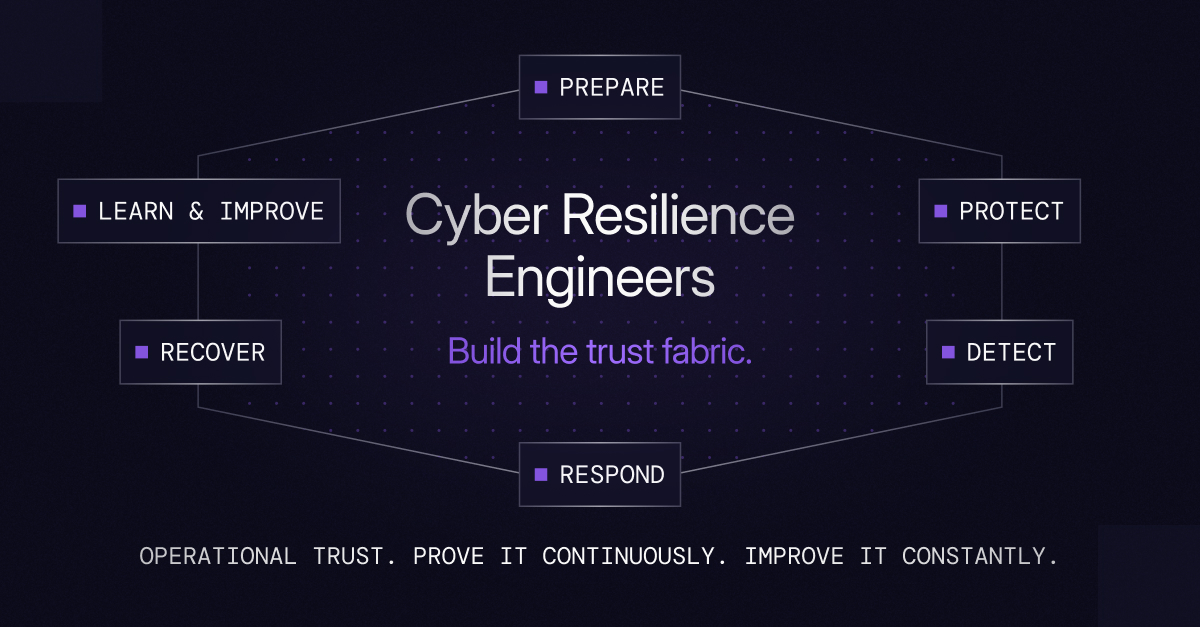
This work is pushing a new role into view: the Cyber Resilience Engineer.
Cyber Resilience Engineers build the trust fabric that connects controls, evidence, backups, policy language, and insurance conditions. Those who do it well share a few traits. They see the whole system. Security, backup, compliance, and insurance aren't separate planets to them. They understand controls, evidence, recovery, policy language, and automation well enough to make those pieces work together.
Show them a manual proof process, and they see a pipeline. Show them a static control statement, and they ask why it isn't continuously verified. Show them a policy requirement, and they ask why it can't be translated into logic and validated in real time.
Many are already using AI to speed up the work that used to be manual. What they're doing has outgrown the old titles. They're more than security engineers, GRC analysts, recovery architects, or risk and insurance operators.
On the best teams, the role already exists; it just hasn't been named. Spektrum has built the engine to back it. Our platform helps Cyber Resilience Engineers move from periodic reporting to measured resilience: prove a control once, reuse the proof wherever it makes sense, and keep it current without having to start over every quarter.
Part II will walk through concrete examples, comparing the old way of proving resilience with the new one, side by side.
Get a taste of how Spektrum empowers Resilience Engineers by testing our Journey for NIST CSF: https://journeys.spektrum.ai/journeys/landing/d66b4cfa-0f79-45cd-863c-b8678e6cc590
Back to Resources

Featured