

.jpg)
Nov 10, 2025
Template
By
J.J. Thompson,
This article is not intended to be definitive, its intended to challenge if CRQ gives us numbers we can use to calculate ROSI on the spot and use that for decision criteria that aligns to residual risk transfer and future accountability to the decisions. Here are my thoughts...
CRQ created solid progress. But CRQ does not illustrate ROSI. Maybe it illustrates pROSI—potential ROSI. The R in ROI (and ROSI) means Return—not a model, but a realized, provable, often GAAP-accountable outcome. CRQ helps us estimate; proof is what turns estimates into returns.
This article builds on that premise with a pragmatic path: don’t discard CRQ; complete it. Treat CRQ as the forward-looking forecast, then close the loop with evidence so you can claim actual returns.
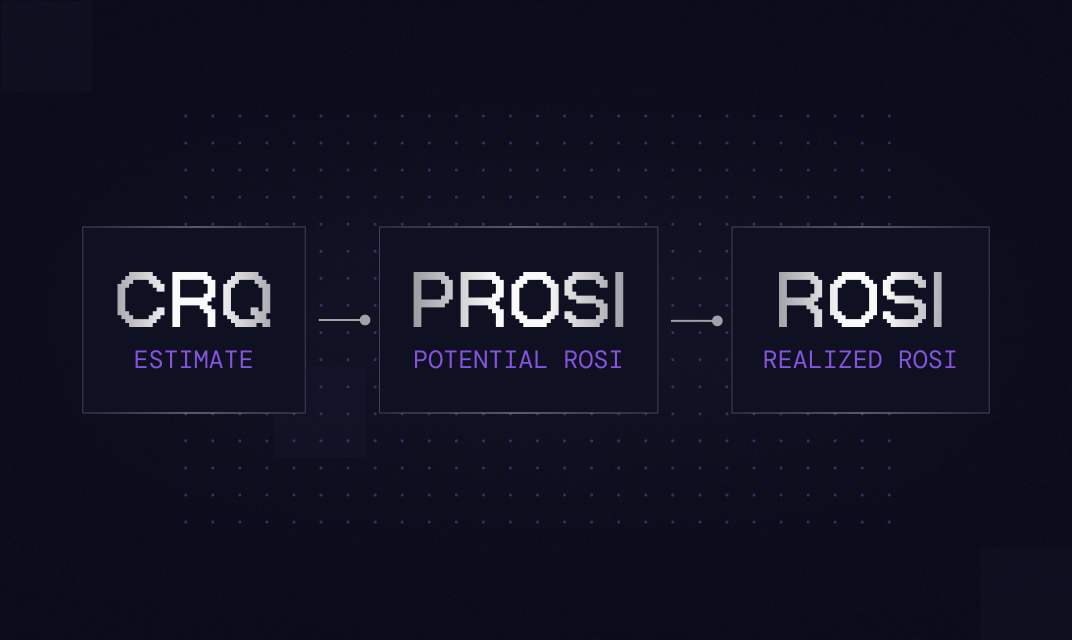
CRQ created solid progress. But CRQ does not illustrate ROSI. Maybe it illustrates pROSI—potential ROSI. The R in ROI (and ROSI) means Return—not a model, but a realized, provable, often GAAP-accountable outcome. CRQ helps us estimate; proof is what turns estimates into returns.
This article builds on that premise with a pragmatic path: don’t discard CRQ; complete it. Treat CRQ as the forward-looking forecast, then close the loop with evidence so you can claim actual returns.
1) First principles: what CRQ is — and isn’t
what crq is good at:
- Common language for leaders. CRQ translates risk into dollars and probabilities boards can reason about.
- Prioritization. It helps security leaders compare initiatives and justify spend... at a macro level.
- Defensibility. It provides structured scenarios, estimated impact, likelihood, so that aggregate calculations can be justified.
-
CRQ created solid progress. But CRQ does not illustrate ROSI. Maybe it illustrates pROSI—potential ROSI. The R in ROI (and ROSI) means Return—not a model, but a realized, provable, often GAAP-accountable outcome. CRQ helps us estimate; proof is what turns estimates into returns. This article builds on that premise with a pragmatic path: don’t discard CRQ; complete it. Treat CRQ as the forward-looking forecast, then close the loop with evidence so you can claim actual returns.
Longer quote or emphasis example lorem ipsum sapien ac erat tristique mollis. Ut tincidunt venenatis id ornare erat congue vestibulum. Ut tincidunt, purus a molestie eleifend, sem mi faucibus ante, quis bibendum tortor ante nec orci. Integer nibh lacus, posuere eget felis vitae, placerat accumsan quam. Suspendisse cursus velit sit amet mattis blandit. Nullam eu ante auctor, blandit erat id, iaculis.
The objective of the board is to know that cyber risk is being defensibly addressed, and then secondarily, that spend is not too much and not too little vs anticipated outcomes. CRQ today does not achieve that objective... with any board members and executive teams I have spoke with. Hey - it could be that I'm simply not talking to the right people yet! CRQ does not measure a realized return. It’s an estimated forecast—and forecasts, by definition, can be wrong.
Probability ≠ performance. A lower modeled likelihood is not the same as a provable and measurable prevention or measurable reduced loss.
Board understanding ≠ financial recognition. The fact that the board “gets” the numbers and thinks that they are "reasonable" doesn’t make them GAAP-accountable calculations for cost avoidance or reduction.
Pullquote example lorem. We're creating Spektrum Fusion™ — an infrastructure layer that turns raw security and backup telemetry into Resilience Tokens™
CRQ created solid progress. But CRQ does not illustrate ROSI. Maybe it illustrates pROSI—potential ROSI. The R in ROI (and ROSI) means Return—not a model, but a realized, provable, often GAAP-accountable outcome. CRQ helps us estimate; proof is what turns estimates into returns.
This article builds on that premise with a pragmatic path: don’t discard CRQ; complete it. Treat CRQ as the forward-looking forecast, then close the loop with evidence so you can claim actual returns.